
The Two Hour New Patient Exam
Dr. Hirschinger’s initial new patient exam is usually about two hours long. Yes, two hours. Why? Because you have likely seen numerous doctors, they have not been able to help you, and you have a lot of questions, which deserved to be answered. A thorough exam usually results in a proper diagnosis from which a treatment plan can be provided. As Dr. Hirschinger says, he only treats invisible pain, which means that if he sees something during the exam, it is not something that he can help you with. The invisible pains he treats are muscle pain in the head, neck, and shoulders, nerve pain in the head, neck, and shoulders, TMJ, which is not a diagnosis but is included here because everyone thinks they have it, primary headaches including migraine, cluster, tension-type headache, etc., and snoring and obstructive sleep apnea. Yes, some people have an actual problem with their temporomandibular joint, which is what TMJ stands for, but most do not. If you were ever told “you have TMJ,” then Dr. Hirschinger is the right person to see and he will educate you as to what is actually causing your pain. As he likes to say, “TMJ is not a diagnosis.™”
The exam includes:
- About 30 minutes of Dr. Hirschinger’s time that he spends before your appointment to review your new patient forms and sometimes communicate with you before the appointment with any questions he might have for you or that need to be answered by other healthcare professionals before your appointment
- About 30 to 40 minutes listening and speaking with you to review your prior treatments, prior imaging, review your health history, etc. He needs the story of how the pain started, what makes it worse, what makes it better, what previous treatment you tried, what medications you take, what previous medications you tried, what medications you take for other reasons, etc.
- Taking your vitals
- A gross neurological exam to rule out any neurological issues
- Measuring the range of motion of your jaw including opening, closing, forward, and side-to-side movements
- Listening to your TMJ with a stethoscope
- Documenting your existing bite
- A palpation of all of the major muscles of the jaw, neck, temple, and shoulders
- A palpation of the various nerves, if necessary, of the front and back of the head
- A manipulation of the jaw
- And a few other items that need to be documented
Each of these are done to see if he can replicate your pain and see what he can to do try to reduce your pain in the office. He will review his findings with you and explain, with visuals, what is causing your pain and give you a diagnosis
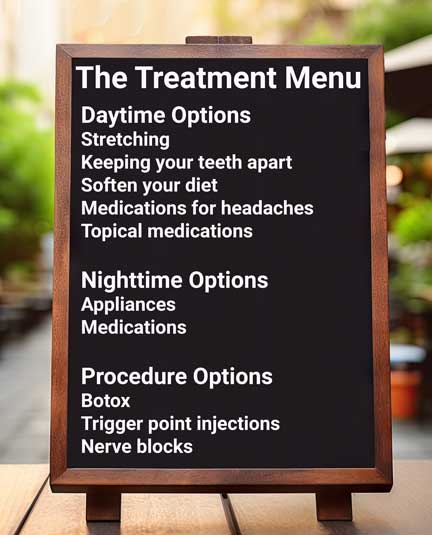
After the diagnosis, he will present different options to treat your pain, which he calls “the menu.” This usually includes steps you can take in your daily life to help yourself:
- Medication options, if indicated
- Nighttime appliance options, if indicated
It is important to note that Dr. Hirschinger is an orofacial pain specialist, and he is held to the standard of care of treating patients the way other orofacial pain specialists treat their patients.
Orofacial pain specialists do not have patients wear an appliance 24/7 for several months with the intent of changing their bite. This is often referred to as:
- Phase 1 – Wearing an appliance 24/7 for several months with the goal of changing the bite.
- Phase 2 – Once the bite has changed, selling treatment to “fix” the bite.
This type of treatment is not taught in any orofacial pain residency and is not considered the standard of care.
Instead, orofacial pain specialists can help patients without touching their teeth or changing their bite. They can also provide care without orthodontic treatment, since most people do not experience pain because of a so-called “bad bite.”
If the bite does play a role in causing pain, it is usually due to:
- Clenching – holding the teeth together too much, which may occur during the day and/or during sleep.
- Grinding – side-to-side and/or front-to-back movement of the lower jaw, usually during sleep, that results in teeth being worn down.
Through proper diagnosis and treatment, these behaviors can be managed, allowing patients to receive relief without unnecessary or non-standard approaches.
If Dr. Hirschinger feels a nighttime appliance is indicated for you, and there is time, he will take digital scans of your teeth to start the appliance fabrication process.
You will be given a Superbill, including your diagnosis codes, that you can submit to your medical insurance for coverage. If you have Medicare, Dr. Hirschinger is not a provider, so you won’t be able to submit it to them for reimbursement. That pretty much covers what is included in the new patient exam, and why it can take up to two hours.
Please visit these links to learn more about different treatment options provided by Dr. Hirschinger at his private practice in Beverly Hills, California.
- Nighttime appliances www.facepaindr.com/dfp
- Botox and trigger point injections www.facepaindr.com/trps
- Mandibular advancement device for treatment of snoring and/or obstructive sleep apnea www.facepaindr.com/madd